
Month-to-Month vs. Long-Term Lease: What Solo Attorneys Need to Know Before Signing
Before you sign a 3-year commercial lease for your new law firm, understand the hidden risks of personal guarantees, NNN pass-throughs, and why month-to-month is safer.

In this article
When a solo attorney decides to open a physical office, the first instinct is often to look for commercial real estate listings. You find a 200-square-foot office in a downtown high-rise, the landlord quotes you $26 per square foot, and the math seems perfectly reasonable.
Then the landlord sends over the lease agreement. Suddenly, that $500 monthly rent transforms into a three-year commitment wrapped in personal guarantees, triple-net pass-throughs, and hidden liabilities.
For a new solo practice, a traditional commercial lease is rarely just a rental agreement. It is a massive assumption of financial risk. Before you sign a multi-year contract, you need to understand exactly what you are agreeing to and why a month-to-month model is often the safer, more profitable choice.
The Hidden Math of a Traditional Commercial Lease
When commercial landlords advertise office space in Cleveland, they typically quote the base rent. According to TenantBase, the average asking rent for office space in Cleveland in 2026 is approximately $21.11 per square foot [1]. For a prime downtown location, that number easily climbs to $26 or $30 per square foot.
But base rent is only the beginning. Most commercial leases are structured as Triple Net (NNN) leases. This means the tenant is responsible for paying the base rent plus their pro-rata share of the building's property taxes, insurance, and Common Area Maintenance (CAM) fees.
"A $3,000/month NNN base rent can reach $3,800 to $4,200/month once taxes, insurance, and CAM are added. Budget from your estimated all-in cost, not the base rate alone." TenantBase [1]
For a solo attorney, those NNN pass-throughs typically add 15% to 30% to the monthly bill. But the monthly cost is not the biggest risk. The biggest risk is the duration.
The Personal Guarantee Problem
Commercial landlords do not like risk. To protect themselves, they almost universally require a three-year to five-year lease term. Furthermore, because a new solo law firm has no established corporate credit history, the landlord will require a personal guarantee.
A personal guarantee bypasses the limited liability protection of your LLC or professional corporation. It makes you personally responsible for the entire value of the lease [2].
If you sign a three-year lease at $520 per month (including NNN), you are not just agreeing to pay $520 next month. You are personally guaranteeing $18,720. If your practice struggles, or if you decide to merge with another firm, or if you simply need to move, the landlord can pursue your personal assets to satisfy the remainder of the contract [2].
See what's available.
Private offices on the 21st floor of Public Square, on flexible terms — with unlimited conference room hours.
View available officesThe Month-to-Month Alternative
The alternative to a traditional commercial lease is an all-inclusive, month-to-month workspace designed specifically for attorneys.
At Law Offices of Cleveland (LOC), the financial model is fundamentally different. There are no NNN pass-throughs, no CAM reconciliations, and no personal guarantees.
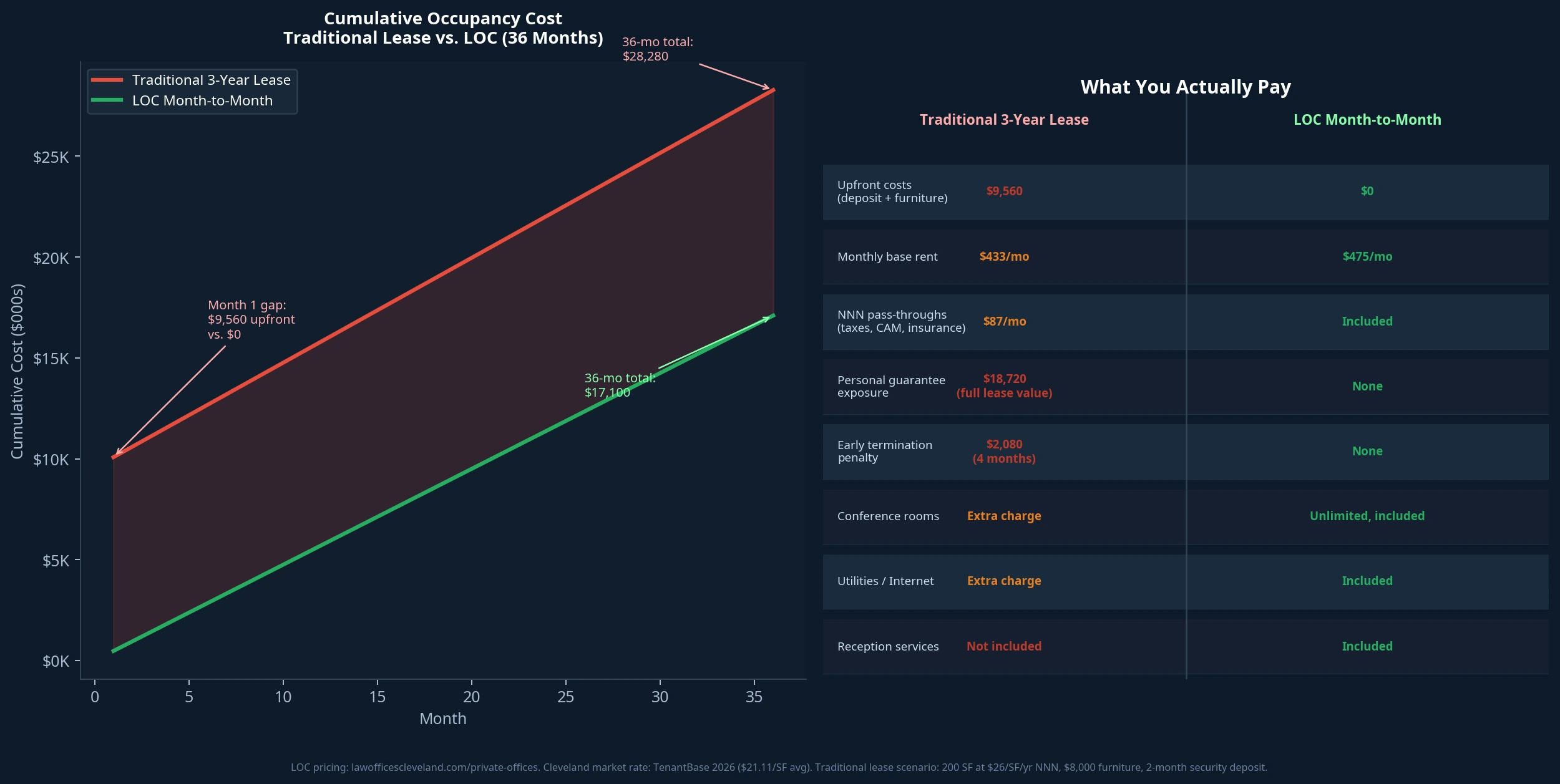
When you compare the two models side-by-side, the advantages of a month-to-month structure become clear.
1. Zero Long-Term Liability
A month-to-month agreement means exactly what it says. You pay for the space you use, while you use it. If your practice grows rapidly and you need to upgrade to a larger suite, you can do so immediately. If you decide to transition to a virtual practice, you can leave without paying a massive early termination penalty. You retain complete financial flexibility.
2. No Upfront Capital Expenditure
When you lease raw commercial space, you have to furnish it. A professional desk, executive chair, client seating, and filing cabinets will easily cost several thousand dollars. You also have to set up commercial internet service and pay for a separate conference room rental whenever you host a deposition.
A private office at LOC is fully furnished and move-in ready. High-speed fiber internet, utilities, and unlimited access to professional conference rooms are included in the flat monthly rate.
3. Predictable Cash Flow
In a traditional NNN lease, your monthly costs fluctuate. If the building's property taxes increase, your rent increases. If the landlord decides to repave the parking lot, your CAM fees go up.
A month-to-month private office provides absolute cost certainty. Your overhead is a fixed, predictable line item every single month. For a solo attorney managing their own cash flow, predictability is invaluable.
Private Offices at LOC: Law Offices of Cleveland offers fully furnished, move-in ready private offices starting at $475 per month. No personal guarantees, no hidden fees, and absolute month-to-month flexibility.
Protect Your Runway
Starting a solo practice requires capital. You need money for malpractice insurance, bar registration, practice management software, and marketing. Tying up thousands of dollars in a commercial security deposit and office furniture is an inefficient use of your startup capital.
More importantly, signing a personal guarantee for a multi-year lease introduces unnecessary stress into an already stressful transition.
You can secure a professional, prestigious address at 55 Public Square without assuming the liabilities of a commercial lease. Explore our private office options today and build your practice on your own terms.
References
[1] TenantBase, "How Much Does Office Space Cost in 2026?", March 13, 2026. https://blog.tenantbase.com/how-much-does-office-space-cost-in-2026 [2] Thames Markey Law, "Do you need a personal guarantee for a commercial lease?", February 17, 2025. https://www.thamesmarkey.law/blog/2025/02/do-you-need-a-personal-guarantee-for-a-commercial-lease/
Frequently asked questions
What is a Triple Net (NNN) lease?
A Triple Net lease is a commercial real estate agreement where the tenant pays a base rent plus their proportional share of the building's property taxes, insurance, and common area maintenance (CAM) fees. These pass-throughs typically add 15% to 30% to the advertised base rent.
What happens if I break a commercial lease early?
Breaking a commercial lease usually triggers severe financial penalties. Landlords typically demand three to six months of rent as a termination fee, and you may remain legally responsible for the rent until the landlord finds a replacement tenant.
Do I have to sign a personal guarantee for a law office?
In a traditional commercial lease, yes. Landlords almost always require new solo attorneys to sign a personal guarantee, which makes your personal assets vulnerable if your firm cannot pay the rent. However, month-to-month attorney workspaces like Law Offices of Cleveland do not require personal guarantees.
Are conference rooms included in a commercial lease?
In a traditional lease, you only get the square footage you pay for. If you want a conference room, you have to lease a larger suite and furnish it yourself. At Law Offices of Cleveland, unlimited access to professional conference rooms is included with every private office.
See what's available.
Private offices on the 21st floor of Public Square, on flexible terms — with unlimited conference room hours.
View available officesThis article is for general information only and is not legal advice. Law Offices of Cleveland is an office-sharing provider, not a law firm, and does not provide legal services. Reading this does not create an attorney-client relationship with anyone. Written and edited with AI assistance; reviewed by LOC.


