
What the ABA's Latest Data Tells Us About Solo Practice in 2026
The ABA's National Lawyer Population Survey reveals that solo practice is the dominant form of private practice, but a massive technology adoption gap threatens new firms.

In this article
As the legal industry gathers in Chicago for the 2026 American Bar Association Annual Conference, solo practitioners have good reason to pay close attention to the data. The ABA's National Lawyer Population Survey and recent industry reports paint a clear picture: solo practice is not just surviving. It is the dominant form of private practice in the United States.
However, the data also reveals a massive structural gap. The attorneys who make up the largest share of the profession are the least likely to adopt the technology that could save them the most time.
Here is what the latest ABA data and 2026 industry trends mean for solo attorneys in Ohio and beyond.
Solo Practice Is the Default, Not the Exception
There is a persistent myth in law school that the "normal" career path leads to a midsize or large firm. The ABA data proves otherwise.
According to the most recent National Lawyer Population Survey, there are approximately 1.37 million active lawyers in the United States [1]. Of those in private practice, nearly half (49%) work as solo practitioners [2]. Furthermore, roughly 40% of all US law firms are one-lawyer practices.
If you are a solo attorney, you are not an outlier. You represent the center of gravity of the American legal profession. The total lawyer population has grown by 5.6% over the last decade, and the solo share is expanding as the overhead costs associated with starting a firm continue to collapse [1] [2].
The Solo Attorney Technology Paradox
While solo attorneys dominate the profession by headcount, they are lagging severely in technology adoption. This is the solo attorney paradox.
According to the ABA's Artificial Intelligence TechReport, generative AI adoption rises steadily with firm size. Nearly half (47.8%) of lawyers at firms with 500 or more attorneys report using generative AI. In contrast, only 17.7% of solo practitioners use it [3].
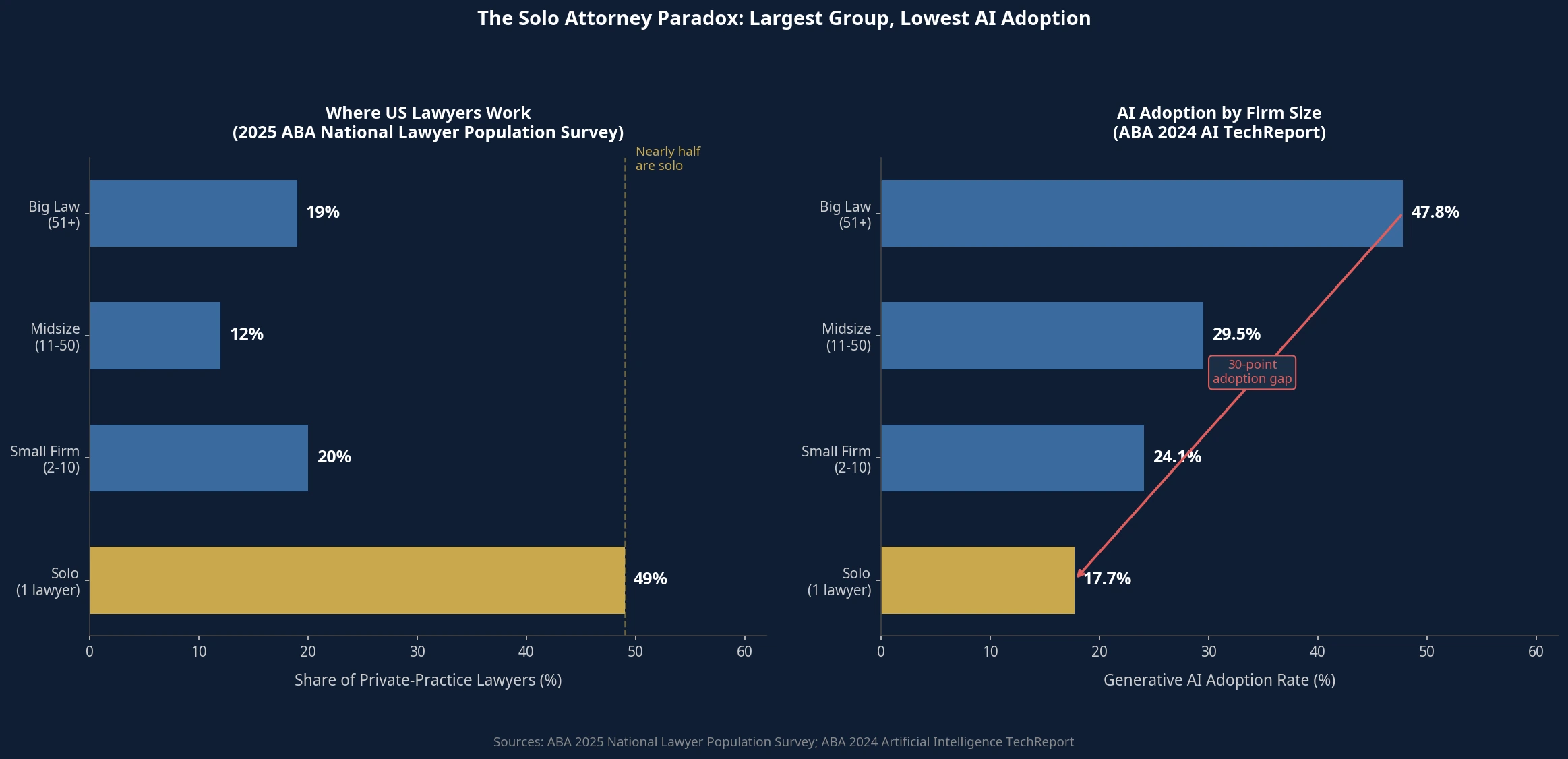
This 30-point adoption gap is a structural problem. A solo lawyer is not just the attorney. They are the intake desk, the billing department, and the back office. Industry data shows that across an eight-hour day, a solo attorney only bills about three hours. The remaining five hours are consumed by administrative and operational tasks [2].
Large firms are adopting AI because they have dedicated IT budgets and innovation teams. Solo attorneys, who actually have the most to gain from automating administrative work, are adopting it the least because they lack the time to evaluate and implement new tools.
Come see the floor.
Twenty minutes. We'll show you the available offices and help you work out which membership actually fits.
Schedule a tourWhat This Means for Your Practice
The data points to a clear conclusion: the overhead that once made solo practice difficult has been replaced by an administrative burden. You no longer need to buy a server or hire a full-time receptionist to open a firm, but you do need a strategy to handle the five hours of non-billable work that will eat your day.
To succeed as a solo attorney in 2026, you must ruthologically protect your time. This means relying on shared infrastructure rather than building it all yourself.
The Infrastructure Advantage: You do not need to lease a traditional commercial office to have a professional presence. By utilizing an attorney-only workspace, you gain access to a professional address, secure mail handling, and unlimited conference room use without the administrative headache of managing a physical office.
When you strip away the fixed costs of a traditional lease and plug into an existing professional infrastructure, you reclaim the time you need to actually practice law. You also position yourself to invest in the practice management software and AI tools that will give you leverage.
If you are ready to build your solo practice on a foundation that supports your growth rather than draining your time, schedule a tour of Law Offices of Cleveland. Our flexible office memberships provide the professional infrastructure you need, allowing you to focus on the work that actually bills.
References
[1] American Bar Association, "U.S. lawyer population up significantly for the first time since 2020." https://www.americanbar.org/news/abanews/aba-news-archives/2025/12/aba-2025-profile-of-the-legal-profession-report/ [2] Referent Law, "US Lawyers by Firm Size: 2026 Statistics." https://referent.law/blog/us-lawyers-by-firm-size-2026-statistics-solo-small-midsize-big-law/ [3] American Bar Association, "2024 Artificial Intelligence TechReport." https://www.americanbar.org/groups/law_practice/resources/tech-report/2024/2024-artificial-intelligence-techreport/
Frequently asked questions
What percentage of lawyers are solo practitioners?
According to the most recent data based on the ABA National Lawyer Population Survey, approximately 49% of all lawyers in private practice work as solo practitioners. Solo practice is the most common firm size in the United States.
How many active lawyers are there in the United States?
The ABA National Lawyer Population Survey reports there are approximately 1.37 million active lawyers in the United States, representing a 5.6% growth over the last decade.
Are solo attorneys adopting AI technology?
Solo attorneys currently have the lowest rate of generative AI adoption in the legal profession. Only 17.7% of solo practitioners report using AI tools, compared to nearly 48% of lawyers at firms with 500 or more attorneys.
How many billable hours does a solo attorney work per day?
Industry data indicates that the average solo attorney only bills about three hours per eight-hour workday. The remaining five hours are typically consumed by administrative tasks, business operations, and client intake.
Come see the floor.
Twenty minutes. We'll show you the available offices and help you work out which membership actually fits.
Schedule a tourThis article is for general information only and is not legal advice. Law Offices of Cleveland is an office-sharing provider, not a law firm, and does not provide legal services. Reading this does not create an attorney-client relationship with anyone. Written and edited with AI assistance; reviewed by LOC.


